Financial Ratios Cheat Sheet 2025 | All Formulas & Quick Reference
Complete financial ratios cheat sheet with formulas. Key accounting ratios for profitability, liquidity, leverage & efficiency in one place.
Financial Ratios Cheat Sheet
Your complete quick-reference guide to the most important financial ratios. Bookmark this page for easy access to all key accounting ratios formulas whenever you need them.
Looking for in-depth explanations? Visit our main financial ratios hub for comprehensive guides on each category.
Overview
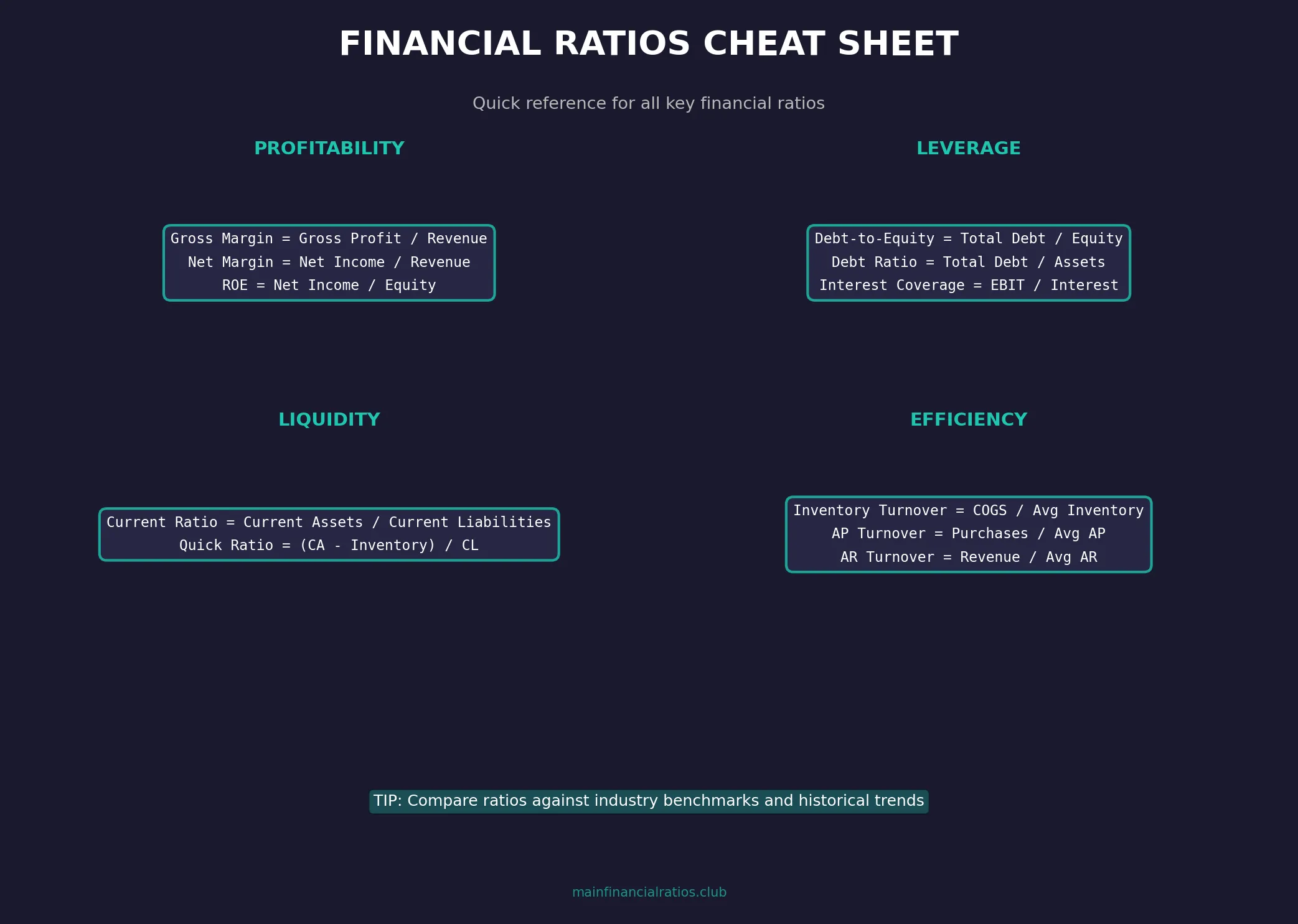
Financial ratios are grouped into four main categories:
- Profitability Ratios — Measure earnings performance
- Liquidity Ratios — Assess short-term solvency
- Leverage Ratios — Evaluate debt levels
- Efficiency Ratios — Analyze operational effectiveness
Profitability Ratios
Profitability ratios reveal how well a company generates profit from its operations. Learn more about profitability ratios →
Gross Profit Margin
Gross Profit Margin = (Revenue - COGS) / Revenue × 100
What it shows: The percentage of revenue remaining after direct costs. Higher is better.
Typical range: 20% - 60% (varies by industry)
Net Profit Margin
Net Profit Margin = Net Income / Revenue × 100
What it shows: The percentage of revenue that becomes actual profit after all expenses.
Typical range: 5% - 20%
Return on Equity (ROE)
ROE = Net Income / Shareholders' Equity × 100
What it shows: How effectively equity is being used to generate profits.
Target: > 15% generally considered good
Return on Assets (ROA)
ROA = Net Income / Total Assets × 100
What it shows: How efficiently assets are being used to generate earnings.
Target: > 5% (industry dependent)
Return on Capital Employed (ROCE)
ROCE = EBIT / (Total Assets - Current Liabilities) × 100
What it shows: Returns generated on long-term capital invested in the business.
Target: Should exceed cost of capital
Liquidity Ratios
Liquidity ratios measure a company’s ability to pay short-term obligations. Learn more about liquidity ratios →
Current Ratio
Current Ratio = Current Assets / Current Liabilities
What it shows: Ability to pay obligations due within one year.
Target: 1.5 - 2.0 (industry dependent)
Quick Ratio (Acid Test)
Quick Ratio = (Current Assets - Inventory) / Current Liabilities
What it shows: Immediate liquidity excluding slow-moving inventory.
Target: > 1.0
Detailed comparison: Current Ratio vs Quick Ratio →
Cash Ratio
Cash Ratio = Cash & Cash Equivalents / Current Liabilities
What it shows: Ability to pay obligations with cash on hand only.
Target: 0.2 - 0.5 (too high may indicate idle cash)
Leverage Ratios
Leverage ratios assess the degree of debt financing. Learn more about leverage ratios →
Debt-to-Equity Ratio
Debt-to-Equity = Total Debt / Shareholders' Equity
What it shows: The mix of debt versus equity financing.
Target: < 1.5 (varies significantly by industry)
Debt Ratio
Debt Ratio = Total Debt / Total Assets
What it shows: Percentage of assets financed by debt.
Target: < 50%
Interest Coverage Ratio
Interest Coverage = EBIT / Interest Expense
What it shows: Ability to pay interest on outstanding debt.
Target: > 3.0x
Equity Ratio
Equity Ratio = Total Equity / Total Assets
What it shows: Proportion of assets financed by shareholders.
Target: > 50%
Efficiency Ratios
Efficiency ratios measure how well a company uses its assets. Learn more about efficiency ratios →
Inventory Turnover
Inventory Turnover = Cost of Goods Sold / Average Inventory
What it shows: How many times inventory is sold and replaced per year.
Target: Higher is generally better (4-8 turns common)
Accounts Receivable Turnover
AR Turnover = Net Credit Sales / Average Accounts Receivable
What it shows: How efficiently credit sales are collected.
Target: Higher is better (10-12 common)
Accounts Payable Turnover
AP Turnover = Total Purchases / Average Accounts Payable
What it shows: How quickly a company pays its suppliers.
Detailed guide: Accounts Payable Turnover Ratio →
Asset Turnover
Asset Turnover = Revenue / Average Total Assets
What it shows: Revenue generated per dollar of assets.
Target: Varies widely (0.5 - 2.5)
Days Conversion Formulas
Convert turnover ratios to days for easier interpretation:
| Metric | Formula |
|---|---|
| Days Inventory Outstanding | 365 / Inventory Turnover |
| Days Sales Outstanding | 365 / AR Turnover |
| Days Payable Outstanding | 365 / AP Turnover |
| Cash Conversion Cycle | DIO + DSO - DPO |
Complete Formula Quick Reference Table
| Category | Ratio | Formula |
|---|---|---|
| Profitability | Gross Margin | (Revenue - COGS) / Revenue |
| Net Margin | Net Income / Revenue | |
| ROE | Net Income / Equity | |
| ROA | Net Income / Total Assets | |
| ROCE | EBIT / Capital Employed | |
| Liquidity | Current Ratio | Current Assets / Current Liabilities |
| Quick Ratio | (CA - Inventory) / CL | |
| Cash Ratio | Cash / Current Liabilities | |
| Leverage | D/E Ratio | Total Debt / Equity |
| Debt Ratio | Total Debt / Assets | |
| Interest Coverage | EBIT / Interest Expense | |
| Efficiency | Inventory Turnover | COGS / Avg Inventory |
| AR Turnover | Revenue / Avg AR | |
| AP Turnover | Purchases / Avg AP | |
| Asset Turnover | Revenue / Avg Assets |
How to Use This Cheat Sheet
Identify your analysis goal — Are you assessing risk, performance, or efficiency?
Select relevant ratios — Don’t calculate everything; focus on what matters for your decision.
Compare appropriately — Always benchmark against:
- Industry averages
- Historical trends
- Competitor performance
Look for patterns — One ratio rarely tells the whole story. Combine metrics for deeper insights.
Consider context — A “bad” ratio might be acceptable given the company’s strategy or lifecycle stage.
Print-Friendly Version
Need this cheat sheet for offline use? Press Ctrl+P (or Cmd+P on Mac) to print this page.
Related Resources
- Profitability Ratios Guide
- Liquidity Ratios Explained
- Leverage Ratios Formula & Interpretation
- Efficiency Ratios & Working Capital
- Return to Main Financial Ratios Home
Last updated: December 2025