Leverage Ratios Formula & Interpretation Guide
Master leverage ratios with clear formulas and interpretation. Learn Debt-to-Equity, Debt Ratio, and Interest Coverage with real examples and industry benchmarks.
Leverage Ratios: Formulas & Interpretation
Leverage ratios are critical financial metrics that measure how much of a company’s capital comes from debt versus equity. Understanding these ratios helps investors, creditors, and analysts assess a company’s financial risk and its ability to meet long-term obligations.
Whether you’re analyzing a potential investment or evaluating your own business, mastering leverage ratios is essential for sound financial decision-making. For a complete overview of all financial metrics, visit our main financial ratios hub.
What Are Leverage Ratios?
Leverage ratios (also called solvency ratios or gearing ratios) quantify the degree to which a company uses borrowed money to finance its operations. They answer a fundamental question: How much does this company rely on debt?
A highly leveraged company has more debt relative to equity, which can:
- Amplify returns when times are good
- Increase risk when revenues decline
- Limit flexibility for future borrowing
Key Leverage Ratio Formulas
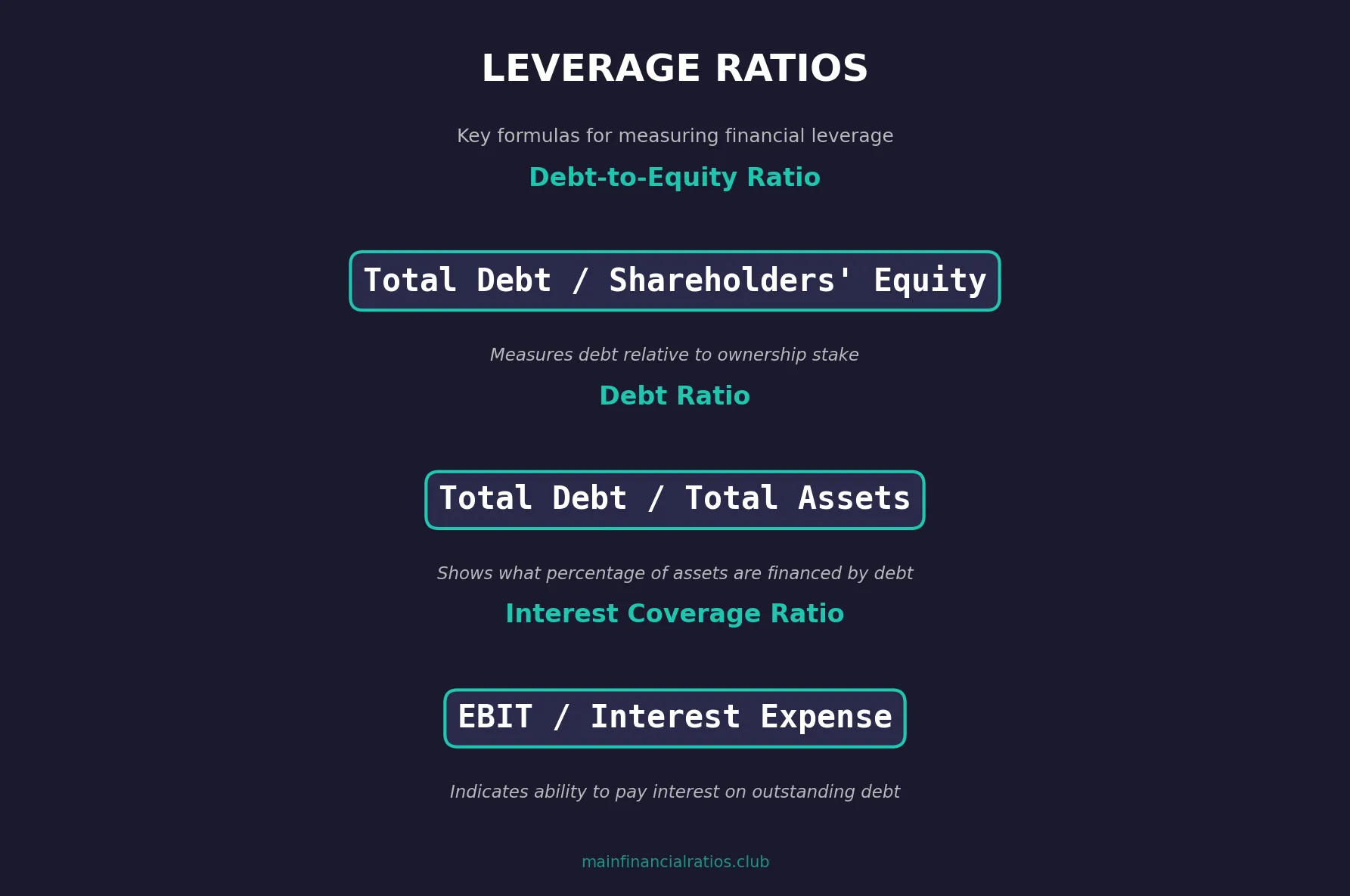
1. Debt-to-Equity Ratio
The debt-to-equity ratio compares total debt to shareholders’ equity, showing how much debt a company uses for every dollar of equity.
Formula:
Debt-to-Equity Ratio = Total Debt / Shareholders' Equity
Example: If a company has $500,000 in total debt and $250,000 in shareholders’ equity:
D/E Ratio = $500,000 / $250,000 = 2.0
This means the company has $2 of debt for every $1 of equity.
Interpretation:
- < 1.0: Conservative financing, more equity than debt
- 1.0 - 2.0: Moderate leverage, common in many industries
- > 2.0: High leverage, higher financial risk
2. Debt Ratio
The debt ratio shows what percentage of a company’s total assets are financed by debt.
Formula:
Debt Ratio = Total Debt / Total Assets
Example: With $500,000 in debt and $1,000,000 in total assets:
Debt Ratio = $500,000 / $1,000,000 = 0.50 (or 50%)
This indicates that half of the company’s assets are financed by debt.
Interpretation:
- < 0.4 (40%): Low leverage, conservative approach
- 0.4 - 0.6: Moderate leverage
- > 0.6 (60%): High leverage, potential concern for creditors
3. Interest Coverage Ratio
The interest coverage ratio (also called times interest earned) measures a company’s ability to pay interest on its outstanding debt.
Formula:
Interest Coverage Ratio = EBIT / Interest Expense
Where EBIT = Earnings Before Interest and Taxes
Example: With EBIT of $200,000 and annual interest expense of $40,000:
Interest Coverage = $200,000 / $40,000 = 5.0x
This company can cover its interest payments 5 times over.
Interpretation:
- < 1.5: Danger zone—may struggle to pay interest
- 1.5 - 3.0: Adequate, but limited margin for error
- > 3.0: Comfortable coverage, lower default risk
How to Interpret Leverage Ratios
Context Matters
Leverage ratios should always be evaluated in context:
Industry Comparison: Capital-intensive industries (utilities, real estate) naturally carry more debt than service businesses.
Historical Trends: Is leverage increasing or decreasing over time? A rising debt-to-equity ratio could signal trouble—or strategic expansion.
Interest Rate Environment: Low interest rates make debt more affordable, potentially justifying higher leverage.
Business Cycle: Companies may increase leverage during expansion and reduce it during recessions.
Warning Signs
Watch for these red flags:
- Debt-to-equity ratio significantly higher than industry peers
- Declining interest coverage ratio over multiple quarters
- Debt ratio approaching or exceeding 70%
- Negative equity (liabilities exceed assets)
Industry Benchmarks
| Industry | Typical D/E Ratio | Notes |
|---|---|---|
| Utilities | 1.0 - 2.0 | Stable cash flows support higher debt |
| Technology | 0.3 - 0.8 | Asset-light, often cash-rich |
| Retail | 0.5 - 1.5 | Varies by business model |
| Manufacturing | 0.8 - 1.5 | Capital-intensive |
| Banking | 8.0 - 15.0 | Highly regulated, unique structure |
Common Mistakes to Avoid
Ignoring Off-Balance-Sheet Debt: Operating leases and other commitments may not appear as debt but still represent obligations.
Using Book Values Only: Market values can differ significantly from book values, especially for equity.
Comparing Across Industries: A D/E ratio of 2.0 is alarming for a tech company but normal for a utility.
Focusing on One Ratio: Use multiple leverage ratios together with liquidity ratios and profitability metrics for a complete picture.
Quick Reference Summary
| Ratio | Formula | Good Range |
|---|---|---|
| Debt-to-Equity | Total Debt / Equity | < 1.5 (varies) |
| Debt Ratio | Total Debt / Assets | < 50% |
| Interest Coverage | EBIT / Interest | > 3.0x |
Related Resources
- Financial Ratios Cheat Sheet — All formulas in one place
- Liquidity Ratios — Current and Quick Ratio explained
- Efficiency Ratios — Turnover and working capital metrics
- Return to Main Financial Ratios Home
Last updated: December 2025